The Esoteric Tarot of Balatro
The Tarot of Balatro
Balatro, a playing card game derived from poker, created and developed by the pseudonymous “LocalThunk” and hereafter referred to as “The Developer,” contains within it a system of Tarot with its own particular function and design. In this system, the 22 Trumps of the Major Arcana, inspired principally in design by the Rider Waite Smith Tarot and hereafter referred to as “RWS,” aid you in various ways in the game. That many of the functions or mechanics of these Tarot Cards reflect recognizable meanings of their corresponding Trumps in The Tarot subsequently suggests that The Developer made real effort to translate The Tarot into the game of Balatro.
Balatro also contains a system of “Boss Blinds,” wherein each poker ante is split into three blinds, the last of which imposes a particular challenge called a Boss Blind. Of the 23 standard Boss Blinds in Balatro, 22 are assigned letters of the Phoenician alphabet, excepting The Flint, standing apart for reasons detailed later. Because the 22 Trumps of the Major Arcana have likewise been assigned the 22 letters of the Hebrew alphabet within several occult systems, the Boss Blinds invite association with The Tarot through their corresponding letters. Speculatively, Phoenician may have been chosen over Hebrew in Balatro to distance the system from cultural immediacy.
The correspondences between Balatro’s Boss Blinds and their associated Trumps are less consistent than those between the Tarot Cards and their own Trumps of The Tarot, often relying instead upon the literal meanings or visual forms of the Phoenician glyphs. For example, the Blind called The Hook is assigned the Phoenician Waw, corresponding to Hebrew Vav, a letter which means “hook.” Its challenging effect of automatically discarding two random cards after every poker hand invokes the image of a hook coming down and pulling your cards out of your hand. This is wonderfully elegant in itself, but bears no distinct relationship to The Hierophant, the Trump attributed to Vav within the Golden Dawn correspondence system underlying the RWS deck.
This writing examines Balatro, as it exists in version 1.0.1o, through lenses of esoteric Tarot, with the RWS deck serving as the principal pictorial reference, and interpretation drawing from the correspondences of the Hermetic Order of the Golden Dawn, hereafter called Yhe Golden Dawn, Papus’s Tarot of the Bohemians, Hermetic Qabalah, occult astrology, and original synthesis.
Alongside the examination of existing mechanical assignments of the Tarot Cards and Boss Blinds of Balatro, I will at times propose reassignment to alternate mechanics present in the game, with a Balatro Tarot Card generally expressing something of its Trump’s archetype, meanings, or correspondences, and a Boss Blind generally expressing the Trump’s weakness, inversion, or an oppressive form of its central principle. These recommendations are matters of comparative best fit within the closed system of Balatro, and are not claims that any attribution is uniquely correct. They too come with the acknowledgment that some Boss Blind names would also need to be reconsidered in order to fit gracefully within the altered schema.
It must be stated clearly that Balatro is first and foremost a playing card game, not a Tarot simulator, and its successful integration of The Tarot at any depth is already a feat. It is in recognition of The Developer’s evident desire for an internally coherent system that I offer my recommendations, should they wish to benefit from the ‘tism of occultism.
Initiation
Prior to assessing the Tarot and Boss Blind systems, several matters require address and definition.
The five Showdown Boss Blinds: Amber Acorn, Verdant Leaf, Violet Vessel, Crimson Heart, and Cerulean Bell, may initially be read as representing the suits of the Tarot: the four suits of The Minor Arcana plus The Major Arcana as a fifth, but they instead draw inspiration from historical European playing card suits, and hold no direct correlation to The Tarot. 1
The 23rd standard Boss Blind, The Flint, is notable because it corresponds to neither a Phoenician letter nor, by extension, a Tarot Trump. The Developer has explained that The Flint was added later in development for a neater arrangement in the game interface. The Flint is accordingly not allocated in this assessment, though its corresponding mechanic is.
Within Golden Dawn systems of occult correspondence, the Trumps of The Tarot are distributed among various astrological elements, including the seven classical planets. Balatro does make use of celestial bodies by assigning Planet Cards to its poker hands; for example, Pluto, a dwarf planet, is cleverly assigned to High Card, the smallest poker hand. This system, however, does not attempt to integrate with Balatro’s system of Tarot. It is understandable why this complex correspondence system would be simplified, and I have followed suit and set aside usage of the Planet cards in Balatro, though general references to occult astrology remain. A fuller use of the Zodiac would nevertheless be a natural conceptual extension of Balatro’s celestial mechanics.
The following table provides the playing card and Minor Arcana suit correspondences used throughout this writing. 2
| Playing Card Suit | Minor Arcana Suit | Element |
|---|---|---|
| ♣ Clubs | Wands | Fire |
| ♥ Hearts | Cups | Water |
| ♠ Spades | Swords | Air |
| ♦ Diamonds | Pentacles | Earth |
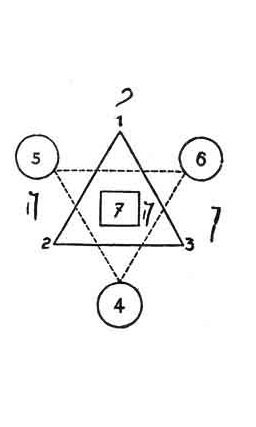
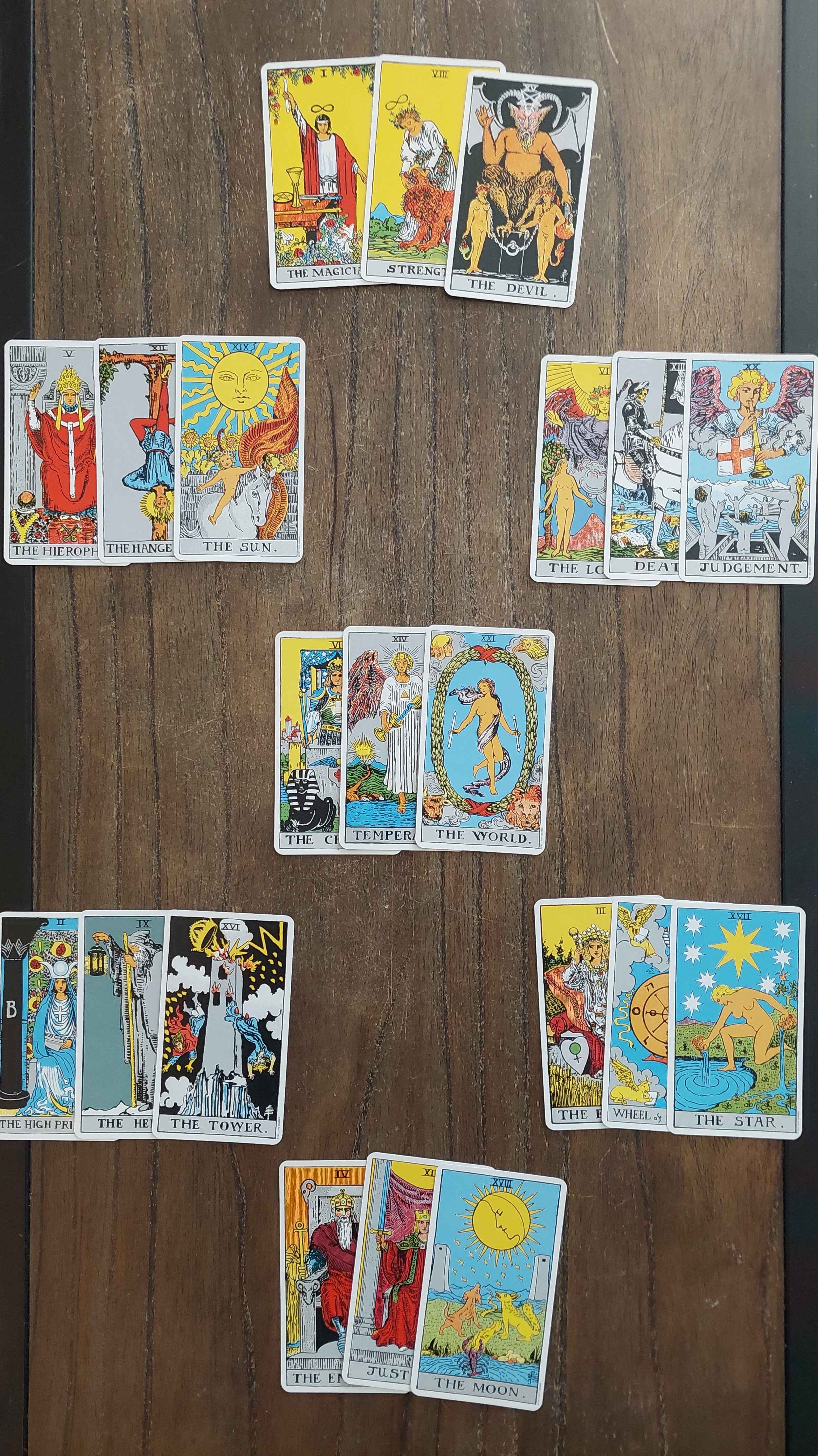
Throughout this writing, I refer to what I call a “Septenary Arrangement,” an ordering adapted from Papus’s Tarot of the Bohemians in which The Fool is set aside and the remaining 21 Trumps are arranged into three repetitions of seven according to the sequence shown below in both formula, left, and result, right. This can be used as a comparative structure through which relationships among Trumps may become more or primarily visible, and for the sake of readability, the cards have been spaced out. Notably, the outer edges of the arrangement should be understood to be cyclical, making The Hierophant and Judgement adjacent, as well as The High Priestess and The Star, much as The Devil and The Lovers are adjacent. 3
You will primarily see below comparative charts for each card of The Major Arcana. The first element is its depiction in Balatro along with what it does in the game. The second element is The RWS version of the Trump. The third element is the Hebrew letter which is assigned to the Trump in esoteric Tarot. The fourth element, to its left, is the Balatro Boss Blind. The Boss Blind is itself comprised of a depicition of a Phoenician letter, and it is paired with the Hebrew letter which the Phoenician one predates and correlates to. The name of the Boss Blind and what challenge it imposes in the game is also listed. Occasionally, Joker cards, the fundamental essences of Balatro, will be referenced and displayed.
You will find a Key below which allows you to move within The Tarot.
Key to The Major Arcana
0. The Fool
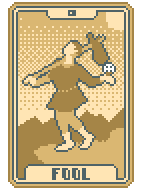
Creates a copy of the last Tarot or Planet card used (The Fool excluded)
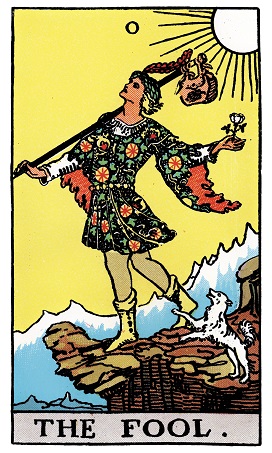
The Fool

The Ox: Playing the most played hand this run sets money to $0

Aleph
In The Tarot, The Fool’s fundamental nature is that of containing the potential for all things while itself being no particular thing, represented by its numerical assignment of 0. Balatro translates this elegantly in that The Fool copies the last Tarot or Planet Card used, remaining empty in itself while spiritually capable of assuming any form, though mechanically constrained in game.
Its associated Boss Blind, The Ox, or perhaps said as The 0x, is cohesive as well: the Blind itself is capable of sending your currency off a cliff and back to the humble $0 should you remain within the comforts of your most used hand, demanding The Fool’s willingness to move beyond itself. You will also see the Aleph of The Ox in the composition of The Fool.
There is also a particular connection to the Joker Card, Vagabond, for one manifestation of The Fool is the destitute wanderer, someone with nothing to their name. Vagabond generates Tarot cards when a poker hand is played with $4 or less, an amount considered destitute within the game, becoming an animating force of Tarot in Balatro just as The Fool animates The Tarot.
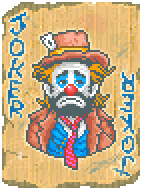
Vagabond
Return to The Key
I. The Magician
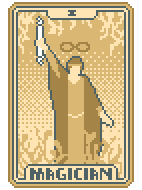
Enhances 2 selected cards to Lucky Cards
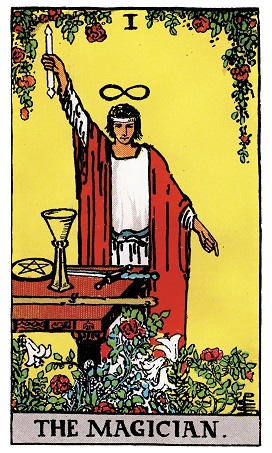
The Magician

The House: First hand is drawn face down

Bet
Where The Fool contains every possibility, The Magician selects 1 and causes it to occur. The Magician is will made manifest, that production of effect whose cause remains unseen and therefore appears as luck, as captured succinctly in the phrase, “Luck is the residue of design.” It is for this reason that The Magician in Balatro is aptly given the power to create Lucky Cards.
Across Balatro, many effects are expressed as probabilities, seen as a 1 in X chance. The Magician may be imagined as that 1: that singular successful outcome made manifest from the field of possibilities.
More deeply within the mechanics of The Magician, Lucky Cards have a 1 in 5 chance of granting Mult and a 1 in 15 chance of granting currency, numerically suggesting The Hierophant, Trump 5, and The Devil, Trump 15. These are almost assuredly incidental, though not empty: The Magician and The Devil occupy the same triplet seen in the Septenary Arrangement, while the RWS imagery of The Magician, The Hierophant, and The Devil share overlapping motifs. Further relationship exists between The Hierophant and The Devil which will be elaborated in greater detail later.
There is also a connection to the Joker card, Lucky Cat, which becomes more powerful each time a Lucky Card triggers. The maneki neko depicted in Lucky Cat has its left paw upright, which traditionally represents a welcome or beckoning. It would be more appropriate with its right paw upright instead, traditionally representing money and luck, aligning with both the card's ethos, as well as with the posture of The Magician.
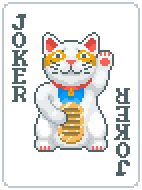
Lucky Cat
The corresponding Blind, which causes the first hand of the round to be drawn face down, lies within reasonable reach of The Magician of Balatro in that the player would need to rely substantially upon luck, or more grandly, upon The Magician’s ability to manifest successful outcome.
Recommended Blind Mechanic: Play only 1 hand
Why: In this mechanic, the theme of 1 becomes an oppressor; just as The Magician has all he requires among the magical tools upon his table, so must the player find all they require in 1 hand, perhaps after Juggling a discard or three.
Return to The Key
II. The High Priestess
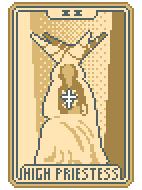
Creates up to 2 random Planet cards
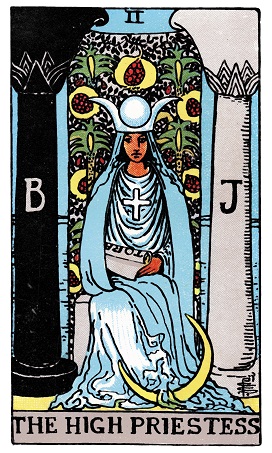
The High Priestess

The Club: All Club cards are debuffed

Gimmel
The generation of Planet cards attributed to The High Priestess is somewhat relational in that there is a certain link to celestials through The High Priestess’ traditional attribution to the Moon, though this mechanic would be more attractive if Balatro’s celestial system preserved the specific object of the Moon.
Recommended Tarot Mechanic: Enhances 1 selected card into a Glass Card
Why: The reflection of the inner world represented by The High Priestess fits naturally within the implications of glass, where the Glass Card magnifies what already is through its X2 mult, 2 invoking The High Priestess. This mechanic also more perfectly foils her counterpart, The Magician; Trump 1 enhances 2 cards, while Trump 2 enhances 1. Where the player would desire the probabilities of The Magician’s Lucky Cards to resolve into action, they would typically desire the probability attached to The High Priestess’ Glass Card to remain inactive.
The High Priestess’ Boss Blind attribution is contradictory in that the suit of Clubs corresponds to Wands and Fire, while The High Priestess is among the most archetypally watery figures of The Tarot.
Recommended Blind Mechanic: First hand is drawn face down
Why: The mystery of your concealed hand is that veil of The High Priestess, that unknowable source that she guards, and she guards it well, to your considerable detriment.
Return to The Key
III. The Empress
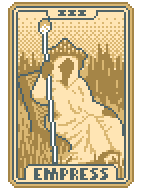
Enhances 2 selected cards to Mult Cards
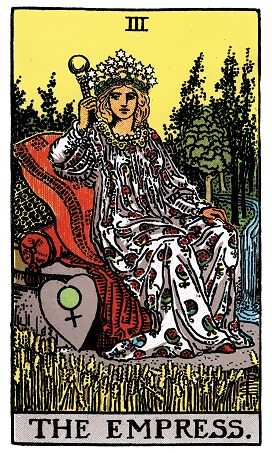
The Empress

The Fish: Cards drawn face down after each hand played

Dalet
The Empress’ association with general fecundity and multiplication through her position as the emergent result of the combination of The Magician and The High Priestess gives rise naturally to her Balatro mechanic of granting Mult.
However, the challenge imposed by The Fish speaks neither to the abundance nor the multiplication represented by The Empress.
Recommended Blind Mechanic: After Play or Discard, always draw 3 cards
Why: This mechanic invokes The Empress directly through the number 3, while turning that number into an oppressive limitation, reducing the abundance of The Empress to a rigid quota.
Return to The Key
IV. The Emperor
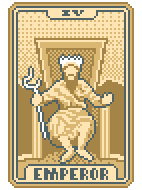
Creates up to 2 random Tarot cards
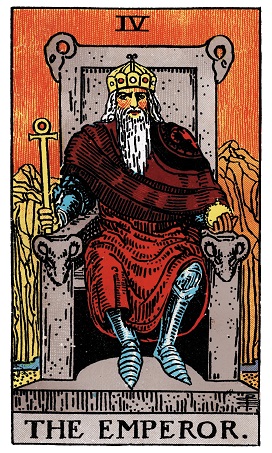
The Emperor

The Window: All Diamond cards are debuffed

Hey
As Trump 4, The Emperor can represent the fourth stage of the Tetragrammaton: Yod He Vav He, or YHVH, written in Hebrew as יהוה, The Emperor corresponding to the second He of the sequence. The Tetragrammaton broadly represents the process of “becoming,” with the second He representing the fourth stage of actualization. More relevantly to The Emperor in Balatro, it also contains the seed necessary for the beginning of a new cycle of becoming. The Emperor’s ability in Balatro to generate Tarot Cards is emblematic of this, especially in that it can generate as one of them The Fool, which, recalling its own Balatro mechanic, may recreate The Emperor and begin the process again; this cycle could theoretically continue ad infinitum, becoming the whole Tarot many times over.
This cycle can too be seen in Balatro’s Ante system, wherein the Small Blind and Big Blind, 1 and 2, establish the foundation for the Boss Blind, 3, while the Ante functions as the abstract 4 that receives these three stages of becoming as a completed whole and carries them into the next cycle. Through this, one may sense how the 4 of The Tetragrammaton is in a certain way the completed 3 with the abstract fourth receiving the preceding terms as a whole. There is something Tetragrammatonlike in the structure of Roguelikes more generally, each completed run returning the player to the seed of another beginning built atop expanding iterations of itself.
Did The Developer intend for this depth? Nothing within Balatro requires that conclusion, though the application of the Tetragrammaton is not surface knowledge of The Tarot. The Developer did retain from the RWS deck the Hebrew letters of the Tetragrammaton in Balatro’s depiction of The Wheel of Fortune, despite otherwise using the Phoenician alphabet, leaving open the possibility of deliberate intention. If the correspondence was not intended and merely a visual relic of the RWS Wheel, it is no less interesting, for within Hermetic frameworks, YHVH is understood as a name, nay more a signature than a name, nay more a pattern than a signature, a pattern said to be of and in all things, and it would therefore be fitting to find its form reproduced here without deliberate design.
The existing Boss Blind mechanic possesses a correspondence in that Diamonds map to Pentacles and therefore Earth and the material world, which may in turn be associated with broad occult concepts of the number 4. Nevertheless, the mechanic has more grounded attribution elsewhere.
Recommended Blind Mechanic: All face cards are debuffed
Why: The Emperor represents the structures of order and law imposed upon the world emerging from Trumps 1 through 3, including the order of The Tetragrammaton, as well as more mundanely, the hierarchy that would allow the royal face cards to possess their royalty and rank at all. An Emperor of severity may therefore withdraw that recognition and taketh away, reducing viceroy to vagabond.
Of visual note, the ankh at the head of The Emperor’s scepter has been replaced by an object resembling an upside down question mark, perhaps referring to the random nature of the Tarot Cards he generates. More speculatively, this alteration may belong to a broader effort to obscure overt religious imagery, also suggested by the alteration of the solar cross worn by The High Priestess.
Return to The Key
V. The Hierophant
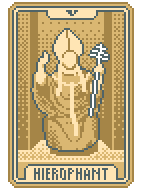
Enhances 2 selected cards to Bonus Cards
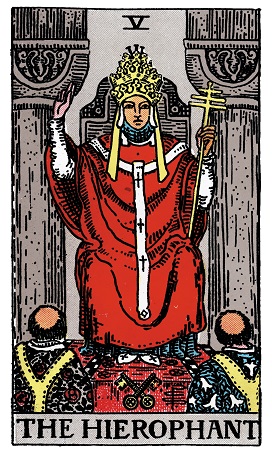
The Hierophant

The Hook: Discards 2 random cards held in hand after every played hand

Vav
In consideration of The Hierophant’s Tarot mechanic, there is perhaps a loose correspondence in the general idea of The Hierophant “blessing” your cards with a Bonus, targeting the number of cards matching the number of fingers he holds up, though this is not especially immediate.
Recommended Tarot Mechanic: Converts up to 3 selected cards to Diamonds
It should be said that I appreciate The Developer’s attempt to attribute the suits of playing cards to The Star, The Sun, and The Moon, though inconveniently, there are only three in the set and four suits of playing cards. The Developer appears to have navigated this by attributing The World as a pseudo fourth member of the quartet, split from the others by Judgement, producing a mechanically convenient but esoterically uneven arrangement.
Why: The suit of Diamonds is more appropriately assigned to The Hierophant, as it is the first Trump in the sequence of the Major Arcana attributed to an Earth sign through Taurus, the fixed sign of Earth. In The Tarot, The Hierophant represents this by being the spiritual principle made manifest through the material forms of religion and rite. Elemental Earth belongs to the Tarot suit of Pentacles, which in turn maps to the playing card suit of Diamonds, with that playing card suit carrying additional material associations: the diamond pip is a four sided shape, recalling the material association with four, the gemstone itself coming from the earth, and its relationship to material wealth consistent with the coin imagery of Pentacles.
Its corresponding Boss Blind, while elegantly derived from the literal meaning of Waw or Vav as described previously, bears no similarly clear relationship to The Hierophant itself, though the visual motif of the Phoenician Waw of The Hook can be seen in The Hierophant’s robe and posture, both clearer in the RWS version.
Recommended Blind Mechanic: All Diamond cards are debuffed
Why: The suit debuff Blinds will be assigned throughout this reconstruction as direct antagonists to the Trumps converting cards to their respective suits; The Hierophant converts cards to Diamonds, and therefore receives the Blind that oppresses Diamond cards.
Return to The Key
VI. The Lovers
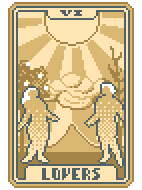
Enhances 1 selected card into a Wild Card
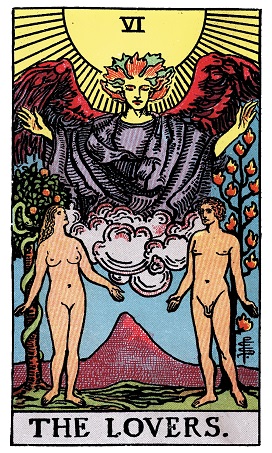
The Lovers

The Manacle: -1 Hand Size

Zayin
The Lovers’ existing Wild Card mechanic could correspond to the dissolving of distinction through the union represented by The Lovers, nullifying the need for suit choice, or perhaps more simply to the wildness of love. Nevertheless, other esoteric correspondences suggest a more attractive suit attribution.
Recommended Tarot Mechanic: Converts up to 3 selected cards to Spades
Why: The Lovers’ astrological attribution is Gemini, an Air sign, leading through elemental Air to Swords in the Minor Arcana and therefore to Spades among playing cards. Regarding The Lovers and Swords, consider too the intuitive doubleedgedness of love.
The Lovers is also attributed to the Hebrew letter Zayin, interpreted as a weapon or sword. Balatro, however, assigns its ancestor, Ziqq, interpreted as a manacle or shackle. 4 This is more comical when considering the context of The Lovers and could hint at a deliberate intention behind the bondage of the existing Boss Blind mechanic, “-1 Hand Size.”
Recommended Blind Mechanic: All Spade cards are debuffed
Why: As the direct antagonist to Spades, the suit to which The Lovers converts cards.
Pictorially, Balatro’s depiction of The Lovers omits the angel present in the RWS depiction. This may reflect the suggested broader removal of overt religious imagery, or a desire to visually distinguish the card more clearly from Judgement; however, the omission may also contribute to a larger pattern considered under The Wheel of Fortune.
Return to The Key
VII. The Chariot
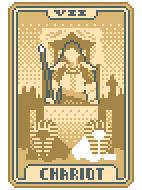
Enhances 1 selected card into a Steel Card
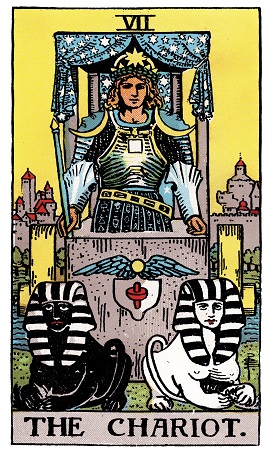
The Chariot

The Wall: Extra large blind

Chet
The attribution of Steel Cards to The Chariot is apt. The cubical chariot which the figure stands within is representative of the material world, while his position rising above its base represents his mastery of it. Steel is likewise of the material world, but is material extended and remade into alloy through the masteries of Man. Further, the most basic interpretation of The Chariot as “victory” is consistent with the ability of Steel Cards to aid many Balatro decks to rise above their base, reaching towards the canopy of the endless.
The existing Blind mechanic of presenting an extra large Blind to mount also works well with The Chariot, in that the victory represented by it is the disciplined mastery and direction of opposing forces of the self, perhaps thought of as a steep wall to climb. The split rectangular motif of the Phoenician Het of The Wall is also visible in the composition of The Chariot’s base and canopy, more plainly seen in the RWS version.
Return to The Key
VIII. Strength
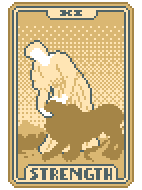
Increases rank of up to 2 selected cards by 1
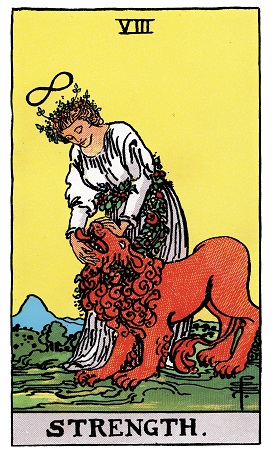
Strength

The Wheel: 1 in 7 cards get drawn face down during the round

Tet
At the outset, it must be pointed out that Strength and Justice in Balatro are numbered XI and VIII, following a valid but older ordering still retained by many traditions of The Tarot, whereas the RWS deck, from which Balatro principally derives its imagery, numbers them VIII and XI. Balatro therefore combines RWS imagery with the older numbering, and it is not known whether this was deliberate or an oversight. In comparing the Boss Blinds, I am following the Golden Dawn and RWS ordering rather than Balatro’s, placing Strength with VIII, The Wheel, and Tet, and Justice with XI, The Goad, and Lamed.
The mechanic of increasing the rank of 2 cards by 1 is well attributed to Strength through prima facie reasoning. Strength may also be read as a spiritual combination of 2 and 1, The High Priestess and The Magician. The woman in Strength pictorially resembles The Empress, who is likewise the emergent result of 2 and 1, though Strength shows this combination through a different lens. Here, the active will of The Magician is turned inward into the contemplative world of The High Priestess, becoming the gentle taming of the hidden nature of the self.
The corresponding mechanic of the Blind, The Wheel, has no tenable relationship to Strength’s attributions, and the mechanic of drawing face down cards has a stronger attribution elsewhere.
Recommended Blind Mechanic: Base Chips and Mult for played poker hands are halved for the entire round
Why: Among the existing Boss Blind mechanics, this is the most direct and absolute weakening of the player’s power, free of the conditionalities that many of the other blinds have; the intuitive concept of Strength is attacked by the intuitive concept of weakness. As a note, this mechanic has been reassigned from The Flint, the outlier of the Boss Blind system. Because The Flint lies outside of allocation for the sake of this assessment, the remaining mechanic after full reassignment is “-1 Hand Size,” which would default to The Flint under this schema.
Return to The Key
IX. The Hermit
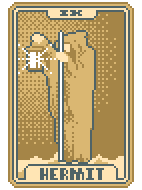
Doubles money
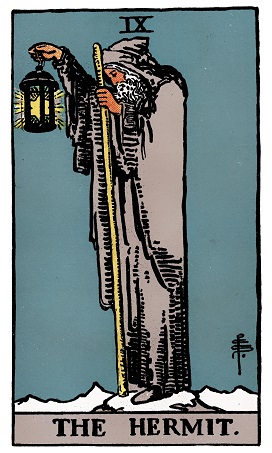
The Hermit

The Arm: Permanently decrease level of played poker hand by 1

Yod
The Developer approaches something by attributing The Hermit to wealth, though the wealth of The Hermit is inward, consisting of wisdom rather than of the material; the mechanic of doubling money is therefore closer to contradiction than correspondence.
Recommended Tarot Mechanic: Creates up to 2 random Planet cards
Why: If there is a mechanic analogous to wisdom in Balatro, it is the leveling of poker hands through Planet Cards, and through this theme of wisdom, the mechanic is well attributed to The Hermit. You may notice that this mechanic was formerly assigned to The High Priestess, with whom The Hermit shares inwardness and contemplation; their relationship is reinforced by their direct proximity within the same triplet seen in the Septenary Arrangement.
The existing Boss Blind of The Arm then becomes an especially fitting oppressor for this new attribution. You will also see the visual motif of the Phoenician Yod of The Arm in the stance of The Hermit, upright with his arm outstretched to the left, clearer in the RWS version.
Return to The Key
X. The Wheel of Fortune
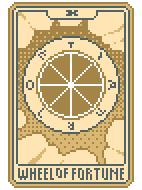
1 in 4 chance to add Foil, Holographic, or Polychrome edition to a random Joker
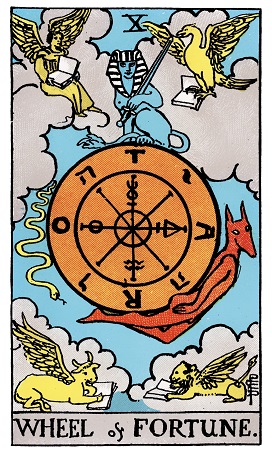
The Wheel of Fortune

The Psychic: Must play 5 cards

Kaf
The Wheel of Fortune’s 1 in 4 chance of producing an effect provides an apt relationship to the number 4, recalling the Tetragrammaton discussed under The Emperor and retained pictorially in Balatro’s depiction of The Wheel as the יהוה interspersed with TORA. Where The Emperor represents the order of the Tetragrammaton, The Wheel represents that order in motion.
In Balatro, The Wheel can produce a significant change of circumstance, and it is the first of a thematic set of three Tarot Cards that operate in and through the realm of the Jokers rather than the playing cards, the other two being Temperance and Judgement. Interestingly, each of these cards is angelic; Temperance and Judgement depict angels directly, while The Wheel draws upon imagery of the Ophanim or Thrones 5. I am admittedly tempted to regard this as coincidence, though the omission of the angel from The Lovers gives the surviving pattern consistency, intended or otherwise. These angelic cards may therefore be read as intermediaries to the higher realm containing the Jokers, reflecting the function of angels as intermediaries between worlds.
This then invokes the concept of the Qabalistic Four Worlds, a conceptualization of the descent of the divine into the material, and the principal layers of Balatro may be correlated to the Four Worlds as follows: the playing cards correspond to Assiah, the World of Action, as the material objects manipulated and played; the Balatro Tarot corresponds to Yetzirah, the World of Formation, as the machinery through which the deck is formed and shaped; the three angelic Tarot Cards then reach upward from Yetzirah into Briah, The World of Creation, where the Jokers preside as the conceptual principles of the game of Balatro; and the Legendary Jokers correspond to Atziluth, the World of Emanation, as exalted exemplars of those principles.
The emanation of Balatro may therefore be imagined as beginning with the archetypal jester, descending into the particular concept of “Joker Poker,” Balatro’s elementary expression, descending further into the mechanics through which that concept is formed and shaped, and finally being received within the actualized game that can be played.
The Four Worlds and the Tetragrammaton are related expressions of the same process of manifestation, and in this context it is again visible how the second He of the Tetragrammaton contains the seed of the next cycle: through playing Balatro on the directly material level, this writing was sparked at the highest level of ideation. That spark then descended into concept, concept into form, and form into the distinct page you are reading now, which may in turn become a spark within you.
Within the logic of its own letter attribution, the Boss Blind of The Psychic is handy in that its Phoenician letter, Kap, meaning palm, clearly relates to The Psychic through palm reading, while the requirement that five cards be played suggests five fingers. There is also an argument to be made in the relationship of The Wheel’s distinct fourness being oppressed by the fiveness demanded by the Blind. However, are we going to keep this assignment? Nope! And we all knew there was never a chance.
Recommended Blind Mechanic: No repeat hand types this round
Why: This restriction forces the player to cycle continually among hand types, turning variation into an oppressive expression of motion in perpetuity.
As a visual note, you will see the Kap of the The Psychic hidden in the spokes of The Wheel, and with circumstance changed in that it is indeed more visible in the Balatro version, rather than the RWS.
Return to The Key
XI. Justice
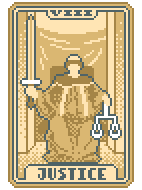
Enhances 1 selected card into a Glass Card
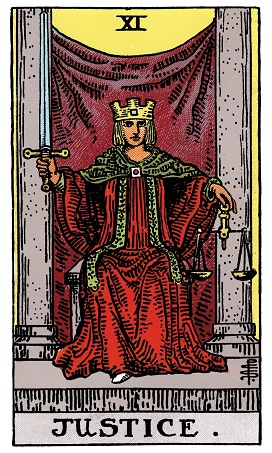
Justice

The Goad: All Spade cards are debuffed

Lamed
The existing mechanic of converting a card into a Glass Card has no transparent relationship to Justice, while The Goad’s debuffing of Spade cards likewise does not adequately measure up.
Recommended Tarot Mechanic: Doubles money
Recommended Blind Mechanic: Lose $1 per card played
Why: Both proposed mechanics for Justice arise through the concept of balance. The Tarot mechanic matches the player’s existing balance, up to its limit of $20, as though placing its equivalent upon the opposite scale. The Blind, conversely, exacts $1 for each card played, establishing a perfect equivalence between action and consequence. In Balatro, the management of one’s currency balance is often among the most careful acts required of the player, and you can imagine a cosmic Justice presiding through gain and loss, ensuring that you are always receiving exactly what you deserve, represented in the Hermetic mantra, “As above, so below.”
Return to The Key
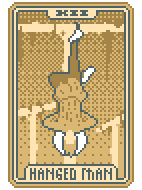
Destroys up to 2 selected cards
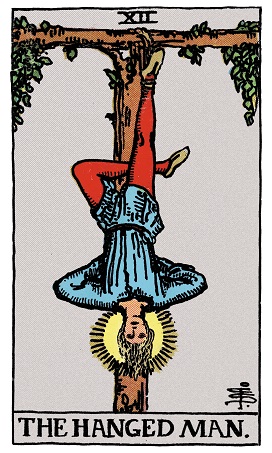
The Hanged Man

The Water: Start with 0 discards

Mem
XII. The Hanged Man
There is cohesion in The Hanged Man’s existing mechanic in that the sacrifice emblematic of the Trump translates naturally into the removal of cards from your deck, while appreciating why a smaller deck may be better requires the reversal of perspective through which less becomes more. Within this reassigned schema, however, The Hanged Man must even sacrifice his own mechanic, which is reassigned to The Tower for reasons considered there.
Recommended Tarot Mechanic: Converts up to 3 selected cards to Hearts
Why: Hearts correspond to the Tarot suit of Cups, which in turn corresponds to the element Water. The Hanged Man corresponds to Mem, meaning “water,” and is directly attributed to elemental Water itself within Golden Dawn derived systems, as reflected in The Hanged Man’s general themes of introspection and passivity.
The existing Boss Blind, The Water, is already well attributed in name through Mem, and while its mechanic of severely limiting discards reasonably correlates to concepts of passivity, within the broader reassignment of the suit debuff Blinds as opposition to the Trumps representing their respective suits, it too must be sacrificed.
Recommended Blind Mechanic: All Heart cards are debuffed
Why: As the direct antagonist to Hearts, the suit to which The Hanged Man converts cards.
Return to The Key
XIII. Death
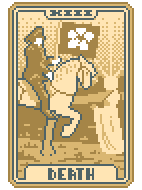
Select 2 cards, convert the left card into the right card
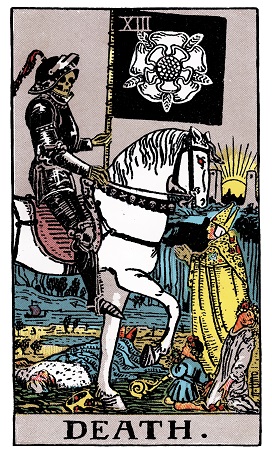
Death

The Serpent: After Play or Discard, always draw 3 cards (ignores hand size)

Nun
The phrase “transformation” has itself been worked nearly to death, and Death may be considered more particularly through the idea of “change.” Through its relation to Water by attribution to Scorpio, the fixed Water sign, it may be considered through the conceptualization of a running river, perhaps the very one behind the skeletal rider of the card, in which from moment to moment is a different configuration while remaining the same river.
Death in Balatro gives distinction through its “conversion” of one card into another; the deck persists as the same whole, even as its internal configuration changes. There is further significance in that the card on the left receives the form of the card on the right. Within the symbolic duality of The Magician and The High Priestess, the right may be read as the active principle of The Magician, and the left as the receptive principle of The High Priestess.
The attributed Boss Blind for Death has been reassigned to The Empress, though it could reasonably have remained with Death for similar reasons. The Empress and Death may be seen as counterparts within the cycle of growth and decay, reflected in the departure and replenishment of cards produced by the Blind mechanic. Nevertheless, the mechanic’s invocation of 3 produces the more natural attribution to The Empress than the 13 of Death. Of note, the visual motif of the Phoenician Nun of The Serpent is also seen in Death, composed of the skeletal rider, the horse, and the clergyman, more clearly in the RWS depiction.
Recommended Blind Mechanic: Cards played previously this Ante are debuffed
Why: This mechanic forces the player to leave behind what previously carried them and yield to change. For those partial to the traditional depiction of Death, such as in the Tarot de Marseille and others, consider an amusing alternate mechanic of “-1 Hand Size.”
As a visual note, to my eye the figure depicted in Balatro’s version of Death resembles a captain more than the skeletal rider of the RWS deck. I pondered whether this was censorship for certain international audiences, though with skeletal imagery appearing with the Joker Card, Mr. Bones, I have no better guess than that it was too difficult to render a discernible skeleton at such small scale.
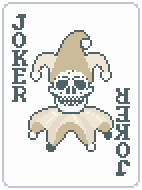
Mr. Bones
Return to The Key
XIV. Temperance
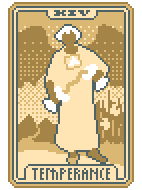
Gives the total sell value of all current Jokers
Temperance

The Pillar: Cards played previously this Ante (during Small and Big Blinds) are debuffed

Samech
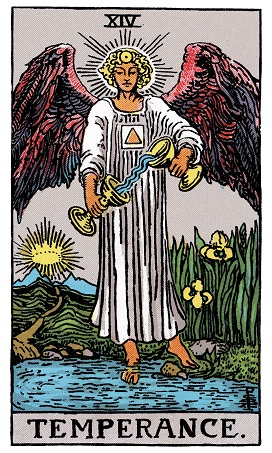
As described under The Wheel of Fortune, Temperance, The Wheel, and Judgement form a thematic set, each of their mechanics operating in and through the realm of the Jokers. For Temperance, this intermediation is especially direct. Whereas The Wheel modifies a Joker and Judgement, as will be discussed later, raises one, Temperance reads the value of the Jokers and pours that value downward into the material currency of the game, just as the angel in Temperance pours between its vessels and blends the material self with the divine.
The existing Boss Blind mechanic of The Pillar could be loosely associated with Temperance by conceptualizing the previous Blinds as substance one and the Boss Blind as substance two of a blended deck of debuffed and unaffected cards, though this mechanic has been more gracefully reassigned to Death. Notably, the visual motif of the Phoenician Samek assigned to The Pillar is also seen in the composition of Temperance, showing the standing angel with outstretched wings, seen more clearly in the RWS depiction.
Recommended Blind Mechanic: Cards drawn face down after each hand played
Why: This Blind requires the player to temper a blended hand of the seen and unseen, the known and veiled. With sufficient mastery and some intuitive guidance, perhaps from the guardian angel, the player may still discern the mixture by moving back and forth between sorting by suit and rank. Like the angel pouring between its vessels, the player works between two arrangements until the blended hand may be alchemized into success.
Return to The Key
XV. The Devil
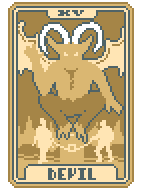
Enhances 1 selected card into a Gold Card
The Devil

The Eye: No repeat hand types this round

Ayin
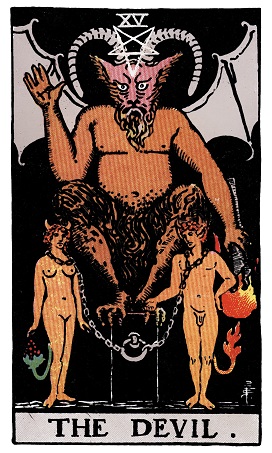
Through its astrological attribution to Capricorn, an Earth sign, and visibly echoed in its Baphometic design, The Devil is rooted in matter, material attachment, and materialism. The existing mechanic of converting a card into Gold is therefore already appropriate, particularly because its wealth is received by bearing its heaviness in your hand. Nevertheless, within this reconstruction, the creation of Gold brings more light when attributed to The World.
Recommended Tarot Mechanic: Enhances 1 selected card into a Stone Card
Why: The same material foundation underlying the original mechanic applies here, but in a more severe form. A Stone Card has been reduced to raw matter and flat material value, possessing neither rank nor suit, and little particular identity. It could therefore represent the heaviness and inertia of material attachment. The Stone Card grants 50 chips, 5 being a motif of The Devil expanded upon below, and is a more viscerally attractive amount than the 30 of a Bonus Card, at a ratio of 5 to 3, or a devilishly suggestive 1.666 repeating unto eternity. The Devil also stands upon a rectangular altar resembling, frankly, a Stone Card.
When taking into account that all Blinds are an opposition and The Devil himself is the archetypal Adversary, nearly any Blind could be attributed to him for that reason alone. The pitfall of The Devil, as discussed, quite literally is a blindness to anything beyond the material. However, seeing beyond this, the mechanic of the associated Boss Blind, The Eye, is not attributable to The Devil in a way that seems particularly diabolical, though consider The Eye as being the eye of The Adversary which oversees all Blinds.
Recommended Blind Mechanic: Must play 5 cards
Why: The Devil is closely related to The Hierophant, both of them concerning the relationship between spirit and its manifestation in the material world. Where The Hierophant gives spirit a form through rite, The Devil mistakes the material for the entirety of existence, stubborn as a goat in its insistence that anything lies beyond it. The Devil is therefore closely associated with 5: it distorts the benediction of The Hierophant, Trump 5, standing itself as Trump 15; it bears a reversed pentagram as its crown; and its raised hand displays the number of cards it demands and which The Eye ensures of: 5. That pain of the oppressive force requiring you to play 5 cards is the decadent bondage of The Devil.
Return to The Key
XVI. The Tower
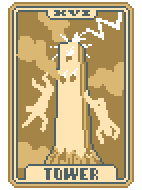
Enhances 1 selected card into a Stone Card
The Tower

The Mouth: Only one hand type can be played this round

Pey
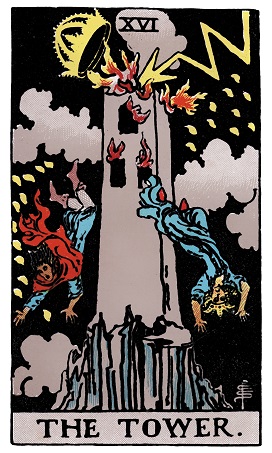
The attribution of The Tower to the generation of Stone Cards seems clear in intention, reducing the Trump’s tower to its literal material of stone. This is perfectly coherent, though the mechanic has been more aptly reassigned to The Devil.
Recommended Tarot Mechanic: Destroys up to 2 selected cards
Why: The Tower is closely associated with destruction and “violent upheaval,” though what is destroyed is the structure of falsehood through the searing gift of enlightenment. What follows The Tower is The Star: once the enveloping structure has fallen, the clear sky above becomes visible. Its destruction is therefore not merely ruin, but the shedding necessary for hope and eventual renewal. This principle is similar to why the destructive mechanic is beneficial in Balatro, as the destruction of these cards refines the remaining deck. There is further correspondence in that the destruction targets two cards, evoking the two figures cast from The Tower, more clearly seen in the RWS Tower.
The existing Boss Blind, through its restriction of the player to 1 hand type, bears a loose relationship to the stark singularity of the monolithic Tower, but is otherwise not particularly relatable to The Tower’s esoterica.
Recommended Blind Mechanic: Discards 2 random cards held in hand after every played hand
Why: This Blind shares the destructive spirit of The Tower’s reassigned Tarot mechanic, and well portrays the catastrophe associated with the Trump; the cards discarded often destroys the player's plans, made false by the discarding. The targeting of two cards again evokes the falling figures of The Tower, though unlike the Tarot mechanic giving you the choice of who falls, the Blind chooses for you.
Return to The Key
XVII. The Star
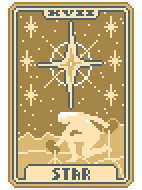
Converts up to 3 selected cards to Diamonds
The Star

The Plant: All face cards are debuffed

Tsade
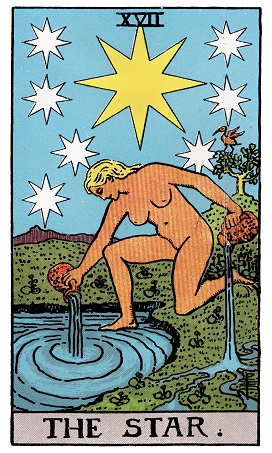
While the subtle design choice of making the focal star of The Star resemble a Diamond through the emphasis of four of its eight rays is stellar, the suit of Diamonds, as described under The Hierophant, does not belong to The Star when considered through esoteric correspondence. The existing Boss Blind mechanic of The Plant likewise bears no particular gleam of The Star.
Recommended Tarot Mechanic: Enhances 2 selected cards to Bonus Cards
Why: The blue streams rising and descending on the design of Bonus Cards evoke the flowing waters of The Star, more visible in the RWS depiction. The mechanic’s targeting of two cards corresponds further to the two vessels from which the figure pours.
Recommended Blind Mechanic: 1 in 7 cards get drawn face down during the round
Why: The figure of The Star is beyond the veil of The High Priestess and has direct access to the mysteries guarded there. Recalling the face down mechanic reassigned to The High Priestess, the face down cards drawn here are representative of the mysterious water drawn by The Star. Additionally, the numbers 1 and 7 invoke 17, or Trump 17, The Star.
Return to The Key
XVIII. The Moon
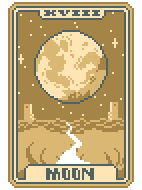
Converts up to 3 selected cards to Clubs
The Moon

The Needle: Play only 1 hand

Qof
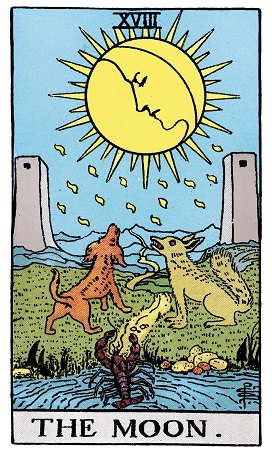
The esoteric meanings of The Moon have no clear relationship to its existing mechanic in Balatro, as Clubs correspond to Wands and Fire, polar to the watery character of The Moon.
Recommended Tarot Mechanic: Enhances 1 selected card into a Wild Card
Why: What The Moon coaxes out is the wildness lying beneath the self, depicted through its three beasts: the domestic dog, the wild wolf, and the primordial crustacean, descending from familiar life into the ancient, where the deepest fears are based. This wildness underlies the attribution of Wild Cards to The Moon, Wild Cards being conceived as a primordial suit from which the standard suits emerge. Of note, the three beasts also invoke The Empress, who sits adjacent The Moon in the Septenary Arrangement, primality being their link.
The Boss Blind mechanic of The Needle is a clever interpretation of the Phoenician glyph Qoph, but does not eye anything specifically lunar. However, the vagueness of The Moon is reflected in the glyph vaguely seen in the composition of the card through the titular Moon and path below it.
Recommended Blind Mechanic: All face cards are drawn face down
Why: In its wildness, The Moon draws out an umbral dehumanization, concealing the humanity of the face cards under its mystery and illusion. This contrasts with The Emperor’s effect: The Emperor debuffs face cards, withdrawing their rank; The Moon conceals them, withdrawing their identity.
As discussed under The High Priestess, there is no celestial Moon Planet Card in Balatro, possibly to avoid confusion with The Moon Tarot Card. Intriguingly, Balatro’s depiction of The Moon is also uniquely naturalistic when compared with the stylization of both the RWS Tarot and Balatro Tarot in general, beckoning speculation that the artwork may at some stage have been considered for the Planet Card system before being repurposed for The Moon Tarot Card.
Return to The Key
XIX. The Sun
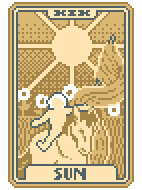
Converts up to 3 selected cards to Hearts
The Sun

The Head: All Heart cards are debuffed

Resh
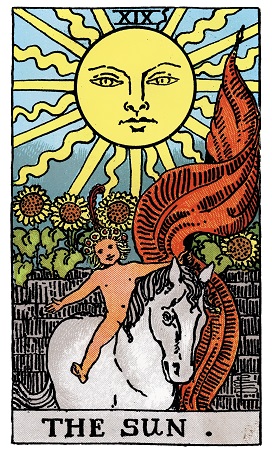
It is ironic that if the suit conversion mechanics of The Moon and The Sun were exchanged, The Moon would correspond more naturally to Hearts, Cups, and Water, while The Sun would correspond to Clubs, Wands, and Fire. An intuitive obstacle in translating playing card suits into elemental correspondences is that Hearts are typically red while Clubs are typically black, encouraging solar and lunar association even though their esoteric correspondences are the opposite.
Recommended Tarot Mechanic: Converts up to 3 selected cards to Clubs
Why: Clubs correspond to Wands, and therefore to Fire. Imagine a club quite literally as a stick, sticks then being fed to flame. Clubs therefore twin naturally with the flame of The Sun.
The Head’s originally assigned mechanic is appropriate to The Sun’s original Hearts conversion, and all we now need is to exchange the focal suit to Clubs. As a visual note, the Phoenician Res of The Head resembles the banner held by the child in The Sun, more distinct in the RWS depiction.
Recommended Blind Mechanic: All Club cards are debuffed
Why: As the direct antagonist to Clubs, the suit to which The Sun converts cards.
Return to The Key
XX. Judgement
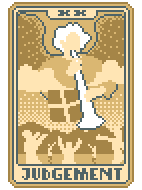
Creates a random Joker card
Judgement

The Tooth: Lose $1 per card played

Shin
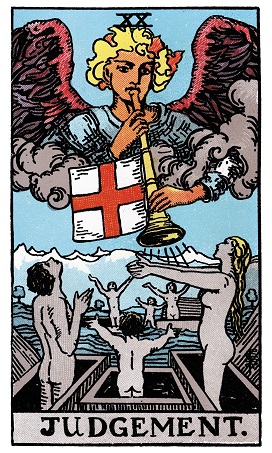
Judgement is the final member of the angelic set described under The Wheel of Fortune and Temperance. Judgement depicts the angel, identified by some as the Archangel Gabriel, raising the dead, though the resurrection represented is not merely that of corpses reanimated within the material world, but of the dead awakening into a higher world. Recalling the Four Worlds described previously, the mechanic may be interpreted as the angel of Judgement awakening some unseen soul into a higher realm, represented in Balatro by the realm of the Jokers.
The associated Boss Blind, The Tooth, could, through its original mechanic, be thought of as eating or chipping at your currency, though this bears no particular calling to Judgement. You will, however, see the "W" motif of the Phoenician Sin of The Tooth, as well as the Hebrew Shin, in the composition of the angel in Judgement.
Recommended Blind Mechanic: Only one hand type can be played this round
Why: With this Blind, judgement is imposed upon the round when the first hand is played. With Judgement representing the trumpeting call to transcendence, the rigid oppression of this Blind may require the player to deny an otherwise wonderful hand whose call to play they are forbidden to answer.
Return to The Key
XXI. The World
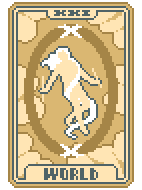
Converts up to 3 selected cards to Spades
The World

The Mark: All face cards are drawn face down

Tav
As described now ad nauseam regarding suit correspondence, The World’s existing mechanic of converting cards to Spades does not universally relate with its esoteric meanings.
Recommended Tarot Mechanic: Enhances 1 selected card into a Gold Card
Why: In our journey through The Tarot, we have arrived at The World and completed what is called the “Great Work,” where the alchemical transmutation guided by The Tarot reaches its culmination. Spiritually, this can be understood as the transmutation and integration of the self into the consciousness of the universe. More fancifully, the completed Great Work is analogous to the successful creation of the alchemical Philosopher’s Stone, through which base matter may be transmuted into gold. It is for this reason that I have chosen the Gold Card mechanic for The World.
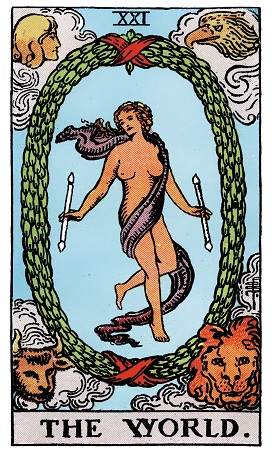
The mechanic of The World’s associated Boss Blind, The Mark, bears no particular relationship to the Trump, though you will visually recognize the four cornered motif of the Taw of The Mark depicted in the four beasts of The World, omitted from the Balatro version, but visible in the RWS version.
Recommended Blind Mechanic: Start with 0 discards
Why: This Blind mechanic corresponds to the zeroness latent within The World, pictorially visible in the wreath surrounding its dancer and cyclically present in the return from The World to Trump 0, The Fool. It also challenges The World’s completion by demanding that the player prove the Great Work of deckbuilding complete. If you have truly integrated yourself with the will of the universe, you will receive the cards you need with no use for discard.
Return to The Key
The Soul
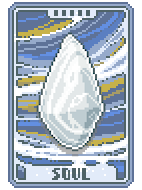
Creates a Legendary Joker
Whereas The World is analogous to the successful creation of the alchemical Philosopher’s Stone, the Spectral Card, The Soul, would be the Stone itself. The Soul is marked with IIIII, or five ones, differentiating it from the Roman numeral V of The Hierophant while retaining reference to the fifth element, Spirit, here called The Soul. The concept of Spirit is represented by the Major Arcana as a whole, but is concentrated at the intersection of The Fool and The World. The 0 of The Fool and the return to 0 within The World both represent the egg or seed: the potential before manifestation and potential renewed after completion. This same seed is represented in The Soul both visually and mechanically, as it gives birth to a Legendary Joker, that is to say, an archetypal Fool. And who said The Fool is excluded from creating itself?
If you are appreciative of my work, please consider contributing any amount below:
https://ko-fi.com/corvusobscurus
Footnotes
1 The suits of Acorns, Leaves, Hearts, and Bells occur in traditional German playing cards, while the suit of Vessels or Cups occurs in traditional Latin playing cards.
2 Playing card suit to Tarot suit correspondences vary, and this writing adopts the convention used by Papus in The Tarot of the Bohemians.
3 The Septenary Arrangement used here is adapted from structures presented by Papus in The Tarot of the Bohemians, although these principles and their application to Tarot belong to a broader occult lineage.
4 Ziqq, interpreted as a fetter, manacle, or shackle, is a proposed reconstruction of an earlier pictorial name associated with the lineage of the letter Zayin.
5 The Wheel of Fortune’s imagery draws from the biblical vision of Ezekiel, which describes creatures accompanied by intersecting wheels. These wheels were later identified with the Ophanim and associated with the order of Thrones.
For while the wanderer pathed crooked, he did himself a crooked wander.