The Tarot Through 6-7
Introduction
What proceeds is that which has been deemed within reasonable tether and cohesion from an exploration of the Tarot through the arbitrary window of the 6-7 phenomenon, and through which is demonstrated the Tarot's universality of precedence.
The Fool
The primary influence is that of The Fool, stating itself plainly in that the grand meaning of 6-7 is that there is no meaning at all.
VI-VII
Then we are clearly led to Trumps VI, The Lovers, and VII, The Chariot. It is relevant that 6-7 is specifically 6-7, and not 6-8, or 5-3, as VI and VII imply the emergence of one another within the expression of adolescent maturity; it is the sexual awakening represented by VI which then sets forth the individual ego represented by VII.
The Juggler
The accompanying gesture of 6-7 clearly evokes juggling prima facie, and through this we become obliged to acknowledge the presence of The Juggler, an identity of Trump I found in The Magician’s negative emanations. Further, if we interpret 6-7 as 6 minus 7, we find that the outcome is negative 1, that is to say a negative expression of Trump I; The Juggler. Trump I could too be said to have The Fool as its first Mate.
The Domination of The First Septenary
More deeply, it is once again relevant that 6-7 is specifically 6-7, for VI leading to VII is what crowns the First Septenary of the Tarot, the domination of which constitutes the first feats of what is called the Great Work. For children as mere pages, there is often fair difficulty integrating these new and abstract layers of being, and those who have endured it should recognize the Juggler which emerges within to desperately moderate the experience. And so, the confounding spell of 6-7 appears broken: it is the particular sarcasm of The Fool manifesting itself through the sacred rites of adolescence.
As Within
Although the young are typically prodigal beyond capacity to see past the immediacies of VI and VII, what is too occurring during that adolescent awakening are their first understandings of the divine as brought by the gift of The Lovers. Within the influences of VI and VII are XVI, The Tower, and XVII, The Star. As with VI and VII, with XVI and XVII, there is again an implication of both within one, and indeed of them all within each other, as their emergence is all four: the divine gift of VI, the self of VII, the flash of XVI, and the spirit of XVII. With the influence of The Star, it could too be said to be their first experiences with the psychic world.
Aquarius
Mostly are tamed, the ordinary fears of Man, with issues the likes of hunger solved to such degree that alchemists synthesize satiety for the purposes of reintroducing it like a culling predator of glut. If this is the case, one must wonder why within safety and stability there feels a weirdness; a distinct imbalance, that is of giving and receipt, of activeness and passivity, and of light and dark, which reaches far beyond the conjurations of the youth. Perhaps it is the Age, or perhaps it is the Age which we make, though within the awakenings of The Star would come the twilight of The Moon and The Devil in its darkness, bringing novel fears of a new order. The tetrad resonance of the Failed Lovers, the Defeated Chariot, the Disputing Tower, and the Corrosive Star then may reflect one: a fear of the Shadow of God; that is a fear of receiving the enlightenment it brings, and of becoming impure by it.
With VI and VII adding to XIII, Death, this may indicate that it is still through the familiar lenses of Man that we perceive this fear, with many expending efforts comparable to ferocious survival to remain themselves sheltered within sanctuaries of false absolution wherein goodness is pretended conquered and evil pretended vanquished. It is then The Juggler that emerges within again, now as the mountebank, the fraud, set forward to desperately maneuver, but to never resolve this fear. But they are left without Strength, for what is traded for purity, that enlightenment that is feared, is too, the divine gift, denied.
It is notable to say that within the nature of fear would lie its dual: hope; The Star. As fear foments, so would its dual, which then through that powerful yet unconscious psychic concentration would that fear become manifest. Thereby, should the choirs of fear continue reverberation, the Shadow may well loose the Reaper for whom is so yearned.
Aleph
That force that Fear would most directly contort is that found in The Fool. It does not take occult sight to understand this in the mind or see this in the material world; witness for yourself the plain diseases of Sardonicism, the archetypal fixations in Horror, or the irreverence of 6-7.
Adding each of the Trumps with immediate association to 6-7, with the obvious implication of 0, is thus: VI + VII + XVI + XVII + I = 47. The Fool reveals its trite humor in that 47 reduces to IV, The Emporer and VII, The Chariot, and adds to XI, Justice. There is a magus of marvelous power who by name alone begs interpretation, and who is at the center of tremendous fear. A perverted power of The Fool in great magnitude is enjoyed by him through the privilege of court jester granted to him by his admirers, and too more subtly by his detractors, who cannot escape its influence. Though be not mistaken: the centeredness described is from the gravity of his immense but absolute will causing a psychic concentration, though he himself is not its absolute source. Rest knowing that this expression of Trump I continues as that of The Juggler, who has not the conduit of The Magician.
It would even, too, be The Fool, 0 itself, which is contorted inward, fearfully coveting its own purity and calling upon its own Death. If this is the case, then it would seem that Trump 0 then would contain the ability of self-correction, in that at certain severity, it being unable to reduce or obliterate, might slip out from underneath itself, or differently said, might collapse inward only to remain precisely where it was, only now somehow elsewhere; inverted, and having its purity of Truth through its release from it. Perhaps then on the fabled dawn of day VIII, salvation should not be said as God come to save us from Belial, but as The Fool come to save us from itself.
Miscellannea
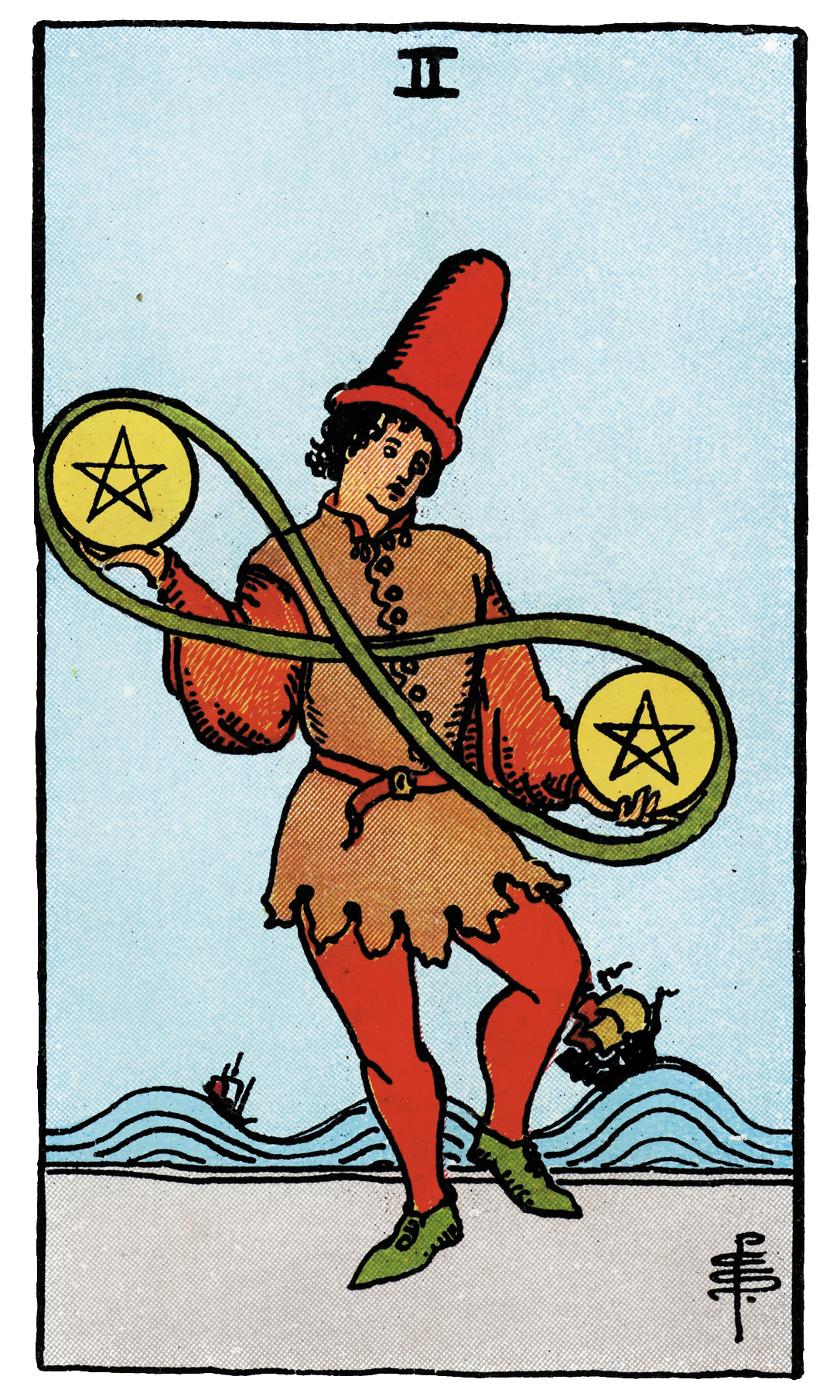
We must also address the Two of Pentacles as it is depicted by Pamela Colman Smith. This card relates pictorially to the gesture of 6-7, and also links back to The Juggler through her apt depiction of The Magician; the same endless cord crowning The Magician now twists between the figure’s pentacles. The card in common divination represents the integration of a change, that is the act of rebalancing your life and priorities as newness emerges. Perhaps then, it is the torrent of novelty which invites invocation of the Two of Pentacles. There is also an association with The Lovers and The Star through water, a representation of the divine spirit. The ambivalent, if not tired figure on the Two of Pentacles is then perhaps a microcosm, for what he has hooked between his Cord of Life are two earthly figures, distinct, but not truly unlike each other, which are balanced with the mirroring vessels at sea.
A paradise become lost may be the only way which it can become gained.